
About
I am a climate scientist who specializes in climate projections, modeling, and data products. Climate projections, modeling and data products are used both by researchers learning more about the weather and climate of Earth, but they are also increasingly used in other ways. For example, a team of researchers may use this information to assess the relationship between local climate and a local ecosystem or stream and the subsequent impacts of a changing climate on that river or stream. Alternatively, local, regional, or even national decision-makers may use this same weather and climate information to understand how people impacted by weather, climate, or climate change as they make decisions for the management of critical systems, such as dams, aquifers, or emergency response. However, these climate projections, models, and data products, collectively climate data products, are all tools to help understand Earth’s climate, the impacts, and make decisions. Would you use a hammer to do a saws job? Of course not! My research focuses on evaluating climate data products, particularly climate projections, for their accuracy, sources of uncertainty, and their appropriate use outside of climate science. Based on this research work, alongside others, I advise users and stakeholders of the appropriate usage for climate data products for their unique needs. The central aspect of my work is that sound scientific research is a critical component needed to inform decision-making and impacts assessments.
I received my PhD and M.S. in Atmospheric Science from the Marine, Earth, and Atmospheric Sciences Department at North Carolina State University in 2016 and 2011 respectively, and my B.S. in Meteorology from North Carolina State University in 2008.
Professional Affiliations
- Research Scientist - University of Oklahoma
- Trusted Reviewer - Institute of Physics
- Associate Editor - Weather, Climate, and Society
- Member - American Meteorological Society
- Member - Academic Freedom Alliance
- Member - Heterodox Academy

Adrienne Wootten
Climate Scientist
Worked With










2026

Sharma, Chetan; Başağaoğlu, Hakan; Schmidt, Logan; Yoosefdoost, Icen; Wootten, Adrienne M.; Bertetti, F. Paul; Şahinli, M. Arif; Arshad, Arfan; Samimi, Maryam; Sharp, John M.; Yang, Changbing; Mirchi, Ali; Chakraborty, Debaditya
Advancing aquifer recharge forecasting through hybrid explainable AI and hydrological modeling Journal Article
In: Geoscience Frontiers, vol. 17, no. 4, 2026, ISSN: 1674-9871.
Abstract | Links | Tags: Journal Article
@article{Sharma2026,

title = {Advancing aquifer recharge forecasting through hybrid explainable AI and hydrological modeling},

author = {Chetan Sharma and Hakan Başağaoğlu and Logan Schmidt and Icen Yoosefdoost and Adrienne M. Wootten and F. Paul Bertetti and M. Arif Şahinli and Arfan Arshad and Maryam Samimi and John M. Sharp and Changbing Yang and Ali Mirchi and Debaditya Chakraborty},

url = {https://www.sciencedirect.com/science/article/pii/S1674987126000903},

doi = {10.1016/j.gsf.2026.102336},

issn = {1674-9871},

year  = {2026},

date = {2026-07-00},

urldate = {2026-07-00},

journal = {Geoscience Frontiers},

volume = {17},

number = {4},

publisher = {Elsevier BV},

abstract = {Reliable aquifer recharge prediction is essential for climate-resilient and sustainable groundwater management, yet uncertainty persists due to subsurface heterogeneity and the lack of direct basin-scale recharge measurements. We present a serial hybrid eXplainable Artificial Intelligence (XAI) framework that leverages hydrological model-derived recharge estimates to train AI models, improving prediction accuracy, transparency, and interpretability. The framework was applied to two basins within the karstic Edwards aquifer system in Texas, USA. The XAI models identified recharge events in the test dataset that were missed by the hydrological model, with findings corroborated by in-situ hydroclimatic records, HSPF recharge estimates, GRACE-derived groundwater storage anomalies, and bootstrap analyses. The results demonstrated the XAI model’s superior learning capability beyond emulators to identify limitations in the training model and test data while robustly predicting high and low aquifer recharge events. Using long-term (1946–2023) hydroclimatic records and SHapley Additive exPlanations (SHAP), the best-performing AI model (Extremely Randomized Trees) identified basin-specific recharge drivers: current-month precipitation dominated in the larger, warmer, and drier basin with perennial streams, while lagged recharge, a proxy for antecedent soil moisture, was the primary driver in the smaller urbanizing basin characterized by small ephemeral streams and highly fractured zones. Each driver explained ∼32% of the variability in recharge estimates, underscoring the model’s generalizability. SHAP-based analysis further enabled probabilistic identification of hydroclimatic conditions conducive to enhanced recharge. Projections based on downscaled CMIP6 climate data under intermediate- and high-emission scenarios indicate a decline in large recharge events in both basins through 2100, highlighting potential risks to groundwater sustainability.},

keywords = {Journal Article},

pubstate = {published},

tppubtype = {article}

}
Ullrich, Paul A.; Feldman, Daniel R.; Alder, Jay; Bewley, Jen; Bukovsky, Melissa; Dixon, Keith; Gutmann, Ethan; Jagannathan, Kripa; Jones, Andrew; Kotamarthi, Rao; Lee, Hugo; Lipschultz, Fred; Littell, Jeremy; Massoud, Elias; McCrary, Rachel; Moss, Richard; Rahimi-Esfarjani, Stefan; Schwarz, Andrew; Spero, Tanya L.; Steinschneider, Scott; Sun, Liqiang; Wootten, Adrienne M.
Advancing a Coordinated Strategy for Decision-Relevant Climate Data Products for the United States Journal Article
In: Bulletin of the American Meteorological Society, 2026, ISSN: 1520-0477.
Abstract | Links | Tags: Journal Article
@article{Ullrich2026,

title = {Advancing a Coordinated Strategy for Decision-Relevant Climate Data Products for the United States},

author = {Paul A. Ullrich and Daniel R. Feldman and Jay Alder and Jen Bewley and Melissa Bukovsky and Keith Dixon and Ethan Gutmann and Kripa Jagannathan and Andrew Jones and Rao Kotamarthi and Hugo Lee and Fred Lipschultz and Jeremy Littell and Elias Massoud and Rachel McCrary and Richard Moss and Stefan Rahimi-Esfarjani and Andrew Schwarz and Tanya L. Spero and Scott Steinschneider and Liqiang Sun and Adrienne M. Wootten},

doi = {10.1175/bams-d-24-0303.1},

issn = {1520-0477},

year  = {2026},

date = {2026-04-17},

urldate = {2026-04-17},

journal = {Bulletin of the American Meteorological Society},

publisher = {American Meteorological Society},

abstract = {Climate adaptation practitioners, planners, and policymakers rely on historical reconstructions and future projections of regional to local climate for adaptation, resilience, and risk management. To serve the many needs of these users, climate data must be relevant for informing the decision-making process (“salient”), consistent with our physical understanding of the global Earth system (“credible”), backed by expert judgment (“authoritative”), and publicly available and ready for use (“accessible”). As more decision-relevant climate data products are being developed to address outstanding needs, important challenges have emerged around the selection, evaluation, use, and standardization of these data products. This article examines opportunities and challenges associated with regional climate data for the United States and describes nascent efforts to build a coordinated strategy among communities of producers and users to maximize the utility of decision-relevant datasets. A community of practice (CoP) is now emerging to benefit both end-users and data producers. The CoP will enable enhanced evaluation protocols, improved uncertainty quantification, and eased data distribution and usage, informed by ongoing input on data needs and feedback on quality and usability of data from a wide range of user communities. Broad coordination among interested parties and periodic reviews of the state of the field are vital to the success of this community of practice.},

keywords = {Journal Article},

pubstate = {published},

tppubtype = {article}

}
2025

Thompson, Liam; Wootten, Adrienne M.; Corporal-Lodangco, Irenea L.; Nielsen-Gammon, John; Trepanier, Jill
A Review: Communicating Uncertainty within the Global Climate Projections Journal Article
In: 2025, ISSN: 1948-8335.
Abstract | Links | Tags: Journal Article
@article{Thompson2025,

title = {A Review: Communicating Uncertainty within the Global Climate Projections},

author = {Liam Thompson and Adrienne M. Wootten and Irenea L. Corporal-Lodangco and John Nielsen-Gammon and Jill Trepanier},

doi = {10.1175/wcas-d-25-0039.1},

issn = {1948-8335},

year  = {2025},

date = {2025-09-30},

urldate = {2025-09-30},

publisher = {American Meteorological Society},

abstract = {<jats:title>Abstract</jats:title>

<jats:p>Uncertainty is inherent to all sciences and can be studied from several different perspectives. However, best practices for climate scientists communicating uncertainty in climate projections are unclear. As anthropogenic greenhouse gas emissions continue to rise, the impacts of human-activity on the climate system have become more apparent. This makes the communication of uncertainty in the climate projections critical to decision-makers. Further, the public often equates science to certainty. Yet, it is critical to understand that climate projections are not the future and that projections themselves contain several sources of uncertainty. As such, this review makes four primary recommendations to guide future research and considerations when communicating uncertainty. The goal is to provide a central place for climate scientists to have crucial conversations on how to communicate this uncertainty to facilitate decision-making. First, a standardized uncertainty communication framework, specific to climate projections, should be developed and implemented. Second, research is needed to determine how to communicate which climate projections are best representing current reality. This is critical given recent funding uncertainties that could impact the ability to make more certain climate projections. Third, there is a lack of research on how different decision-makers perceive uncertainty, which could point to a need to develop industry-specific uncertainty communication practices when developing a larger, universal uncertainty communication framework. Finally, we recommend investigating whether too much emphasis is placed on the potential impacts of climate change (negative framing of uncertainty) rather than on actions the public can take to reduce the projected warming (positive framing).</jats:p>},

keywords = {Journal Article},

pubstate = {published},

tppubtype = {article}

}
<jats:p>Uncertainty is inherent to all sciences and can be studied from several different perspectives. However, best practices for climate scientists communicating uncertainty in climate projections are unclear. As anthropogenic greenhouse gas emissions continue to rise, the impacts of human-activity on the climate system have become more apparent. This makes the communication of uncertainty in the climate projections critical to decision-makers. Further, the public often equates science to certainty. Yet, it is critical to understand that climate projections are not the future and that projections themselves contain several sources of uncertainty. As such, this review makes four primary recommendations to guide future research and considerations when communicating uncertainty. The goal is to provide a central place for climate scientists to have crucial conversations on how to communicate this uncertainty to facilitate decision-making. First, a standardized uncertainty communication framework, specific to climate projections, should be developed and implemented. Second, research is needed to determine how to communicate which climate projections are best representing current reality. This is critical given recent funding uncertainties that could impact the ability to make more certain climate projections. Third, there is a lack of research on how different decision-makers perceive uncertainty, which could point to a need to develop industry-specific uncertainty communication practices when developing a larger, universal uncertainty communication framework. Finally, we recommend investigating whether too much emphasis is placed on the potential impacts of climate change (negative framing of uncertainty) rather than on actions the public can take to reduce the projected warming (positive framing).</jats:p>

E. C. Massoud A. M. Wootten, C. Raymond
“Which Projections Do I Use?” Strategies for Climate Model Ensemble Subset Selection Based on Regional Stakeholder Needs Journal Article
In: Wiley Geophysical Research Letters, vol. 52, iss. 13, 2025.
Abstract | Links | Tags: Journal Article
@article{nokey,

title = {“Which Projections Do I Use?” Strategies for Climate Model Ensemble Subset Selection Based on Regional Stakeholder Needs},

author = {A. M. Wootten, E. C. Massoud, C. Raymond},

url = {https://agupubs.onlinelibrary.wiley.com/doi/10.1029/2025GL116492},

doi = {10.1029/2025GL116492},

year  = {2025},

date = {2025-07-01},

journal = {Wiley Geophysical Research Letters},

volume = {52},

issue = {13},

abstract = {Climate model (or earth system model) projections are increasingly used for climate adaptation planning and impact assessments. As part of this process, many end‐users evaluate a subset of downscaled climate projections without being aware of the implications of downscaling methodology for statistics or event outcomes. Approaches for determining a subset of global climate models to use often focus on values from the raw models, rather than from their downscaled counterparts, in other words assuming that the statistical distribution of the multi‐model ensemble does not change post downscaling. This study demonstrates that a downscaled ensemble will typically retain the change distribution as a raw ensemble, but individual models can differ dramatically post‐downscaling. We recommend that subset‐selection methods account for this possibility and that decision‐relevant downscaled climate projections provide proper descriptions of fitness‐for‐purpose and essential caveats, so that non‐specialists can interpret the results with an appropriate level of confidence.},

keywords = {Journal Article},

pubstate = {published},

tppubtype = {article}

}

Tefera, Gebrekidan W.; Ray, Ram L.; Wootten, Adrienne M.
Changes in Plant Hardiness Zones under Climate Change Scenarios in the South-Central United States Journal Article
In: vol. 64, no. 4, pp. 339–351, 2025, ISSN: 1558-8432.
Abstract | Links | Tags: Journal Article
@article{Tefera2025,

title = {Changes in Plant Hardiness Zones under Climate Change Scenarios in the South-Central United States},

author = {Gebrekidan W. Tefera and Ram L. Ray and Adrienne M. Wootten},

doi = {10.1175/jamc-d-24-0080.1},

issn = {1558-8432},

year  = {2025},

date = {2025-04-00},

urldate = {2025-04-00},

volume = {64},

number = {4},

pages = {339--351},

publisher = {American Meteorological Society},

abstract = {<jats:title>Abstract</jats:title>

<jats:p>Climate change scenarios have been developed for the south-central United States, indicating a minimum temperature change. These scenarios have combined multiple emission scenarios, global climate model simulations, and statistical downscaling techniques. The scenarios are for the midcentury (2036–65) and far-future (2070–99) period. Based on the USDA definitions, plant hardiness zones were delineated under different climate change scenarios. These zones divide the geography into zones by 10°F (5.56°C) increments from each zone. Climate projections developed from RCP4.5 and RCP8.5 emission scenarios project an increase in minimum temperature, while climate projections under the RCP2.6 emissions’ scenario (RCP2.6; 2070–99) project a decrease in minimum temperature. The increase in minimum temperature triggers an expansion of warm plant hardiness zones (PHZs). In the ensemble mean of climate projections under RCP8.5, 2070–99, 27% of the south-central United States will change from hardiness zones 9a and 9b to 10a and 10b, and 23% will change from PHZ10 (10a and 10b) to PHZ11 (11a and 11b). The most significant transition in all climate change scenarios occurs from PHZ9 to PHZ10. Plant hardiness zone mapping under diverse climate change scenarios corroborates that the southern region of Texas may experience heat stress, while Colorado and Kansas may benefit from an expansion of thermally suitable areas for plant growth.</jats:p>},

keywords = {Journal Article},

pubstate = {published},

tppubtype = {article}

}
<jats:p>Climate change scenarios have been developed for the south-central United States, indicating a minimum temperature change. These scenarios have combined multiple emission scenarios, global climate model simulations, and statistical downscaling techniques. The scenarios are for the midcentury (2036–65) and far-future (2070–99) period. Based on the USDA definitions, plant hardiness zones were delineated under different climate change scenarios. These zones divide the geography into zones by 10°F (5.56°C) increments from each zone. Climate projections developed from RCP4.5 and RCP8.5 emission scenarios project an increase in minimum temperature, while climate projections under the RCP2.6 emissions’ scenario (RCP2.6; 2070–99) project a decrease in minimum temperature. The increase in minimum temperature triggers an expansion of warm plant hardiness zones (PHZs). In the ensemble mean of climate projections under RCP8.5, 2070–99, 27% of the south-central United States will change from hardiness zones 9a and 9b to 10a and 10b, and 23% will change from PHZ10 (10a and 10b) to PHZ11 (11a and 11b). The most significant transition in all climate change scenarios occurs from PHZ9 to PHZ10. Plant hardiness zone mapping under diverse climate change scenarios corroborates that the southern region of Texas may experience heat stress, while Colorado and Kansas may benefit from an expansion of thermally suitable areas for plant growth.</jats:p>

Sharma, Chetan; Başağaoğlu, Hakan; Yoosefdoost, Icen; Wootten, Adrienne; Chakraborty-Reddy, Debarati; Bertetti, F. Paul; Mirchi, Ali; Chakraborty, Debaditya
Efficacy of mitigation strategies for aquifer sustainability under climate change Journal Article
In: Nat Sustain, vol. 8, no. 1, pp. 44–53, 2025, ISSN: 2398-9629.
Links | Tags: Journal Article
@article{Sharma2024,

title = {Efficacy of mitigation strategies for aquifer sustainability under climate change},

author = {Chetan Sharma and Hakan Başağaoğlu and Icen Yoosefdoost and Adrienne Wootten and Debarati Chakraborty-Reddy and F. Paul Bertetti and Ali Mirchi and Debaditya Chakraborty},

doi = {10.1038/s41893-024-01477-6},

issn = {2398-9629},

year  = {2025},

date = {2025-01-00},

urldate = {2025-01-00},

journal = {Nat Sustain},

volume = {8},

number = {1},

pages = {44--53},

publisher = {Springer Science and Business Media LLC},

keywords = {Journal Article},

pubstate = {published},

tppubtype = {article}

}
2024

Wootten, A. M.; Başağaoğlu, H.; Bertetti, F. P.; Chakraborty, D.; Sharma, C.; Samimi, M.; Mirchi, A.
Customized Statistically Downscaled CMIP5 and CMIP6 Projections: Application in the Edwards Aquifer Region in South‐Central Texas Journal Article
In: Earth's Future, vol. 12, no. 10, 2024, ISSN: 2328-4277.
Abstract | Links | Tags: Journal Article
@article{Wootten2024,

title = {Customized Statistically Downscaled CMIP5 and CMIP6 Projections: Application in the Edwards Aquifer Region in South‐Central Texas},

author = {A. M. Wootten and H. Başağaoğlu and F. P. Bertetti and D. Chakraborty and C. Sharma and M. Samimi and A. Mirchi},

doi = {10.1029/2024ef004716},

issn = {2328-4277},

year  = {2024},

date = {2024-10-00},

urldate = {2024-10-00},

journal = {Earth's Future},

volume = {12},

number = {10},

publisher = {American Geophysical Union (AGU)},

abstract = {<jats:title>Abstract</jats:title><jats:p>Climate projections are being used for decision‐making related to climate mitigation and adaptation and as inputs for impacts modeling related to climate change. The plethora of available projections presents end users with the challenge of how to select climate projections, known as the “practitioner's dilemma.” In addition, if an end‐user determines that existing projections cannot be used, then they face the additional challenge of producing climate projections for their region that are useful for their needs. We present a methodology with novel features to address the “practitioner's dilemma” for generating downscaled climate projections for specific applications. We use the Edwards Aquifer region (EAR) in south‐central Texas to demonstrate a process to select a subset of global climate models from both the CMIP5 and CMIP6 ensembles, followed by downscaling and verification of the accuracy of downscaled data against historical data. The results show that average precipitation changes range from a decrease of 10.4 mm to an increase of 25.6 mm, average temperature increases from 2.0°C to 4.3°C, and the number of days exceeding 37.8°C (100°F) increase by 35–70 days annually by the end of century. The findings enhance our understanding of the potential impacts of climate change on the EAR, essential for developing effective regional management strategies. Additionally, the results provide valuable scenario‐based projected data to be used for groundwater and spring flow modeling and present a clearly documented example addressing the “practitioner's dilemma” in the EAR.</jats:p>},

keywords = {Journal Article},

pubstate = {published},

tppubtype = {article}

}

de Moulpied, Michael; Robertson, Clinton R.; Smith, Ryan; Johnson, Matthew; Wootten, Adrienne M.; Martin, Elinor; Lopez, Roel; Randklev, Charles R.
In: Aquatic Conservation, vol. 34, no. 8, 2024, ISSN: 1099-0755.
Abstract | Links | Tags: Journal Article
@article{deMoulpied2024,

title = {Growth and longevity of two imperilled mussel species from the Edwards Plateau of Central Texas and its implications for freshwater mussel conservation and management},

author = {Michael de Moulpied and Clinton R. Robertson and Ryan Smith and Matthew Johnson and Adrienne M. Wootten and Elinor Martin and Roel Lopez and Charles R. Randklev},

doi = {10.1002/aqc.4224},

issn = {1099-0755},

year  = {2024},

date = {2024-08-00},

urldate = {2024-08-00},

journal = {Aquatic Conservation},

volume = {34},

number = {8},

publisher = {Wiley},

abstract = {<jats:title>Abstract</jats:title><jats:p><jats:list>

<jats:list-item><jats:p>Life history information such as growth and longevity have been useful for understanding evolutionary relationships and predicting species responses to management and habitat alteration for aquatic species. For unionid mussels, which are globally imperilled, life history information remains unknown for a majority of unionid mussels and because of this has not been broadly used to guide mussel conservation efforts.</jats:p></jats:list-item>

<jats:list-item><jats:p>To address this knowledge gap, growth and longevity were estimated for <jats:italic>Cyclonaias petrina</jats:italic>, Texas pimpleback, and <jats:styled-content style="fixed-case"><jats:italic>Lampsilis bracteata</jats:italic></jats:styled-content>, Texas fatmucket, using thin‐sectioning and validated using cross‐dating. Both species are proposed for listing under the US Endangered Species Act.</jats:p></jats:list-item>

<jats:list-item><jats:p>Growth and longevity estimates differed between <jats:styled-content style="fixed-case"><jats:italic>C. petrina</jats:italic></jats:styled-content> (<jats:italic>K</jats:italic> = 0.065, 0.086, 0.101; <jats:italic>L∞</jats:italic> = 55.03, 76.44, 94.43) and <jats:styled-content style="fixed-case"><jats:italic>L. bracteata</jats:italic></jats:styled-content> (<jats:italic>K</jats:italic> = 0.187, 0.208; <jats:italic>L∞</jats:italic> = 61.40, 61.52), and growth for <jats:styled-content style="fixed-case"><jats:italic>L. bracteata</jats:italic></jats:styled-content> correlated to annual flow indices. Cross‐dating revealed high interseries correlations (<jats:italic>R</jats:italic> = 0.400–0.573), indicating estimates can be viewed with some certainty.</jats:p></jats:list-item>

<jats:list-item><jats:p>Growth and longevity estimates indicate <jats:styled-content style="fixed-case"><jats:italic>C. petrina</jats:italic></jats:styled-content> is positioned near the <jats:italic>K</jats:italic> endpoint and <jats:styled-content style="fixed-case"><jats:italic>L. bracteata</jats:italic></jats:styled-content> near the <jats:italic>r</jats:italic> endpoint along the <jats:italic>r</jats:italic>/<jats:italic>K</jats:italic> life history continuum. This suggests <jats:styled-content style="fixed-case"><jats:italic>C. petrina</jats:italic></jats:styled-content> should be favoured in stable habitats where disturbance is minimal, whereas <jats:styled-content style="fixed-case"><jats:italic>L. bracteata</jats:italic></jats:styled-content> is expected to tolerate habitats with frequent and likely stochastic patterns of disturbance.</jats:p></jats:list-item>

<jats:list-item><jats:p>Knowledge of growth and longevity along with life history position provides a qualitative basis to help scientists and practitioners better anticipate how species will respond to environmental change and management actions. Given the conservation status of <jats:styled-content style="fixed-case"><jats:italic>C. petrina</jats:italic></jats:styled-content> and <jats:styled-content style="fixed-case"><jats:italic>L. bracteata</jats:italic></jats:styled-content> the life history findings from this study are timely and should be useful in their conservation.</jats:p></jats:list-item>

</jats:list></jats:p>},

keywords = {Journal Article},

pubstate = {published},

tppubtype = {article}

}
<jats:list-item><jats:p>Life history information such as growth and longevity have been useful for understanding evolutionary relationships and predicting species responses to management and habitat alteration for aquatic species. For unionid mussels, which are globally imperilled, life history information remains unknown for a majority of unionid mussels and because of this has not been broadly used to guide mussel conservation efforts.</jats:p></jats:list-item>
<jats:list-item><jats:p>To address this knowledge gap, growth and longevity were estimated for <jats:italic>Cyclonaias petrina</jats:italic>, Texas pimpleback, and <jats:styled-content style="fixed-case"><jats:italic>Lampsilis bracteata</jats:italic></jats:styled-content>, Texas fatmucket, using thin‐sectioning and validated using cross‐dating. Both species are proposed for listing under the US Endangered Species Act.</jats:p></jats:list-item>
<jats:list-item><jats:p>Growth and longevity estimates differed between <jats:styled-content style="fixed-case"><jats:italic>C. petrina</jats:italic></jats:styled-content> (<jats:italic>K</jats:italic> = 0.065, 0.086, 0.101; <jats:italic>L∞</jats:italic> = 55.03, 76.44, 94.43) and <jats:styled-content style="fixed-case"><jats:italic>L. bracteata</jats:italic></jats:styled-content> (<jats:italic>K</jats:italic> = 0.187, 0.208; <jats:italic>L∞</jats:italic> = 61.40, 61.52), and growth for <jats:styled-content style="fixed-case"><jats:italic>L. bracteata</jats:italic></jats:styled-content> correlated to annual flow indices. Cross‐dating revealed high interseries correlations (<jats:italic>R</jats:italic> = 0.400–0.573), indicating estimates can be viewed with some certainty.</jats:p></jats:list-item>
<jats:list-item><jats:p>Growth and longevity estimates indicate <jats:styled-content style="fixed-case"><jats:italic>C. petrina</jats:italic></jats:styled-content> is positioned near the <jats:italic>K</jats:italic> endpoint and <jats:styled-content style="fixed-case"><jats:italic>L. bracteata</jats:italic></jats:styled-content> near the <jats:italic>r</jats:italic> endpoint along the <jats:italic>r</jats:italic>/<jats:italic>K</jats:italic> life history continuum. This suggests <jats:styled-content style="fixed-case"><jats:italic>C. petrina</jats:italic></jats:styled-content> should be favoured in stable habitats where disturbance is minimal, whereas <jats:styled-content style="fixed-case"><jats:italic>L. bracteata</jats:italic></jats:styled-content> is expected to tolerate habitats with frequent and likely stochastic patterns of disturbance.</jats:p></jats:list-item>
<jats:list-item><jats:p>Knowledge of growth and longevity along with life history position provides a qualitative basis to help scientists and practitioners better anticipate how species will respond to environmental change and management actions. Given the conservation status of <jats:styled-content style="fixed-case"><jats:italic>C. petrina</jats:italic></jats:styled-content> and <jats:styled-content style="fixed-case"><jats:italic>L. bracteata</jats:italic></jats:styled-content> the life history findings from this study are timely and should be useful in their conservation.</jats:p></jats:list-item>
</jats:list></jats:p>

Wootten, Adrienne M.; Dixon, Keith W.; Adams‐Smith, Dennis J.; McPherson, Renee A.
False springs and spring phenology: Propagating effects of downscaling technique and training data Journal Article
In: Intl Journal of Climatology, vol. 44, no. 6, pp. 2021–2040, 2024, ISSN: 1097-0088.
Abstract | Links | Tags: Journal Article
@article{Wootten2024b,

title = {False springs and spring phenology: Propagating effects of downscaling technique and training data},

author = {Adrienne M. Wootten and Keith W. Dixon and Dennis J. Adams‐Smith and Renee A. McPherson},

doi = {10.1002/joc.8438},

issn = {1097-0088},

year  = {2024},

date = {2024-05-00},

urldate = {2024-05-00},

journal = {Intl Journal of Climatology},

volume = {44},

number = {6},

pages = {2021--2040},

publisher = {Wiley},

abstract = {<jats:title>Abstract</jats:title><jats:p>Projected changes to spring phenological indicators (such as first leaf and first bloom) are of importance to assessing the impacts of climate change on ecosystems and species. The risk of false springs (when a killing freeze occurs after plants of interest bloom), which can cause ecological and economic damage, is also projected to change across much of the United States. Given the coarse nature of global climate models, downscaled climate projections have commonly been used to assess local changes in spring phenological indices. Few studies that examine the influence of the sources of uncertainty sources in the downscaling approach on projections of phenological changes. This study examines the influence of sources of uncertainty on projections of spring phenological indicators and false spring risk using the South Central United States. The downscaled climate projections were created using three statistical downscaling techniques applied with three gridded observation datasets as training data and three global climate models. This study finds that projections of spring phenological indicators and false spring risk are primarily sensitive to the choice of global climate models. However, this study also finds that the formulation of the downscaling approach can cause errors representing the daily low‐temperature distribution, which can cause errors in false spring risk by failing to capture the timing between the last spring freeze and the first bloom. One should carefully consider the downscaling approach used when using downscaled climate projections to assess changes to spring phenology and false spring risk.</jats:p>},

keywords = {Journal Article},

pubstate = {published},

tppubtype = {article}

}

Tefera, Gebrekidan Worku; Ray, Ram L.; Wootten, Adrienne M.
Evaluation of statistical downscaling techniques and projection of climate extremes in central Texas, USA Journal Article
In: Weather and Climate Extremes, vol. 43, 2024, ISSN: 2212-0947.
Links | Tags: Journal Article
@article{Tefera2024,

title = {Evaluation of statistical downscaling techniques and projection of climate extremes in central Texas, USA},

author = {Gebrekidan Worku Tefera and Ram L. Ray and Adrienne M. Wootten},

doi = {10.1016/j.wace.2023.100637},

issn = {2212-0947},

year  = {2024},

date = {2024-03-00},

urldate = {2024-03-00},

journal = {Weather and Climate Extremes},

volume = {43},

publisher = {Elsevier BV},

keywords = {Journal Article},

pubstate = {published},

tppubtype = {article}

}
2023
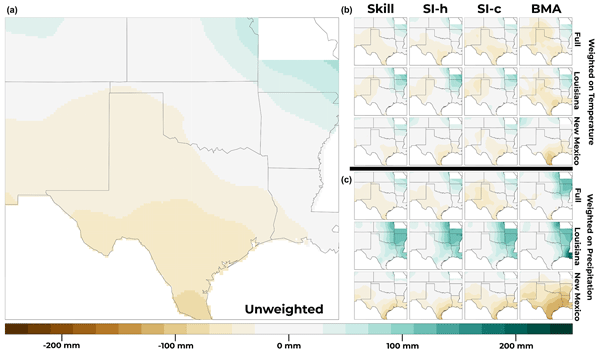
Wootten, Adrienne M.; Massoud, Elias C.; Waliser, Duane E.; Lee, Huikyo
Assessing sensitivities of climate model weighting to multiple methods, variables, and domains in the south-central United States Journal Article
In: Earth Syst. Dynam., vol. 14, no. 1, pp. 121–145, 2023, ISSN: 2190-4987.
Abstract | Links | Tags: Journal Article
@article{Wootten2023,

title = {Assessing sensitivities of climate model weighting to multiple methods, variables, and domains in the south-central United States},

author = {Adrienne M. Wootten and Elias C. Massoud and Duane E. Waliser and Huikyo Lee},

doi = {10.5194/esd-14-121-2023},

issn = {2190-4987},

year  = {2023},

date = {2023-00-00},

urldate = {2023-00-00},

journal = {Earth Syst. Dynam.},

volume = {14},

number = {1},

pages = {121--145},

publisher = {Copernicus GmbH},

abstract = {<jats:p>Abstract. Given the increasing use of climate projections and multi-model

ensemble weighting for a diverse array of applications, this project

assesses the sensitivities of climate model weighting strategies and their

resulting ensemble means to multiple components, such as the weighting

schemes, climate variables, or spatial domains of interest. The purpose of

this study is to assess the sensitivities associated with multi-model

weighting strategies. The analysis makes use of global climate models from

the Coupled Model Intercomparison Project Phase 5 (CMIP5) and their

statistically downscaled counterparts created with the localized constructed

analogs (LOCA) method. This work focuses on historical and projected future

mean precipitation and daily high temperatures of the south-central United

States. Results suggest that the model weights and the corresponding

weighted model means can be sensitive to the weighting strategy that is

applied. For instance, when estimating model weights based on Louisiana

precipitation, the weighted projections show a wetter and cooler

south-central domain in the future compared to other weighting strategies.

Alternatively, for example, when estimating model weights based on New

Mexico temperature, the weighted projections show a drier and warmer

south-central domain in the future. However, when considering the entire

south-central domain in estimating the model weights, the weighted future

projections show a compromise in the precipitation and temperature

estimates. As for uncertainty, our matrix of results provided a more certain

picture of future climate compared to the spread in the original model

ensemble. If future impact assessments utilize weighting strategies, then

our findings suggest that how the specific weighting strategy is used with

climate projections may depend on the needs of an impact assessment or

adaptation plan.

                    </jats:p>},

keywords = {Journal Article},

pubstate = {published},

tppubtype = {article}

}
ensemble weighting for a diverse array of applications, this project
assesses the sensitivities of climate model weighting strategies and their
resulting ensemble means to multiple components, such as the weighting
schemes, climate variables, or spatial domains of interest. The purpose of
this study is to assess the sensitivities associated with multi-model
weighting strategies. The analysis makes use of global climate models from
the Coupled Model Intercomparison Project Phase 5 (CMIP5) and their
statistically downscaled counterparts created with the localized constructed
analogs (LOCA) method. This work focuses on historical and projected future
mean precipitation and daily high temperatures of the south-central United
States. Results suggest that the model weights and the corresponding
weighted model means can be sensitive to the weighting strategy that is
applied. For instance, when estimating model weights based on Louisiana
precipitation, the weighted projections show a wetter and cooler
south-central domain in the future compared to other weighting strategies.
Alternatively, for example, when estimating model weights based on New
Mexico temperature, the weighted projections show a drier and warmer
south-central domain in the future. However, when considering the entire
south-central domain in estimating the model weights, the weighted future
projections show a compromise in the precipitation and temperature
estimates. As for uncertainty, our matrix of results provided a more certain
picture of future climate compared to the spread in the original model
ensemble. If future impact assessments utilize weighting strategies, then
our findings suggest that how the specific weighting strategy is used with
climate projections may depend on the needs of an impact assessment or
adaptation plan.
</jats:p>
2021

Wootten, Adrienne M.; Dixon, Keith W.; Adams‐Smith, Dennis J.; McPherson, Renee A.
Statistically downscaled precipitation sensitivity to gridded observation data and downscaling technique Journal Article
In: Intl Journal of Climatology, vol. 41, no. 2, pp. 980–1001, 2021, ISSN: 1097-0088.
Abstract | Links | Tags: Journal Article
@article{Wootten2020b,

title = {Statistically downscaled precipitation sensitivity to gridded observation data and downscaling technique},

author = {Adrienne M. Wootten and Keith W. Dixon and Dennis J. Adams‐Smith and Renee A. McPherson},

doi = {10.1002/joc.6716},

issn = {1097-0088},

year  = {2021},

date = {2021-02-00},

urldate = {2021-02-00},

journal = {Intl Journal of Climatology},

volume = {41},

number = {2},

pages = {980--1001},

publisher = {Wiley},

abstract = {<jats:title>Abstract</jats:title><jats:p>Future climate projections illuminate our understanding of the climate system and generate data products often used in climate impact assessments. Statistical downscaling (SD) is commonly used to address biases in global climate models (GCM) and to translate large‐scale projected changes to the higher spatial resolutions desired for regional and local scale studies. However, downscaled climate projections are sensitive to method configuration and input data source choices made during the downscaling process that can affect a projection's ultimate suitability for particular impact assessments. Quantifying how changes in inputs or parameters affect SD‐generated projections of precipitation is critical for improving these datasets and their use by impacts researchers. Through analysis of a systematically designed set of 18 statistically downscaled future daily precipitation projections for the south‐central United States, this study aims to improve the guidance available to impacts researchers. Two statistical processing techniques are examined: a ratio delta downscaling technique and an equi‐ratio quantile mapping method. The projections are generated using as input results from three GCMs forced with representative concentration pathway (RCP) 8.5 and three gridded observation‐based data products. Sensitivity analyses identify differences in the values of precipitation variables among the projections and the underlying reasons for the differences.Results indicate that differences in how observational station data are converted to gridded daily observational products can markedly affect statistically downscaled future projections of wet‐day frequency, intensity of precipitation extremes, and the length of multi‐day wet and dry periods. The choice of downscaling technique also can affect the climate change signal for variables of interest, in some cases causing change signals to reverse sign. Hence, this study provides illustrations and explanations for some downscaled precipitation projection differences that users may encounter, as well as evidence of symptoms that can affect user decisions.</jats:p>},

keywords = {Journal Article},

pubstate = {published},

tppubtype = {article}

}
2020
Wootten, Adrienne; Massoud, Elias; Sengupta, Agniv; Waliser, Duane; Lee, Huikyo
The Effect of Statistical Downscaling on the Weighting of Multi-Model Ensembles of Precipitation Journal Article
In: Climate, vol. 8, no. 12, 2020, ISSN: 2225-1154.
Abstract | Links | Tags: Journal Article
@article{Wootten2020,

title = {The Effect of Statistical Downscaling on the Weighting of Multi-Model Ensembles of Precipitation},

author = {Adrienne Wootten and Elias Massoud and Agniv Sengupta and Duane Waliser and Huikyo Lee},

doi = {10.3390/cli8120138},

issn = {2225-1154},

year  = {2020},

date = {2020-12-00},

urldate = {2020-12-00},

journal = {Climate},

volume = {8},

number = {12},

publisher = {MDPI AG},

abstract = {<jats:p>Recently, assessments of global climate model (GCM) ensembles have transitioned from using unweighted means to weighted means designed to account for skill and interdependence among models. Although ensemble-weighting schemes are typically derived using a GCM ensemble, statistically downscaled projections are used in climate change assessments. This study applies four ensemble-weighting schemes for model averaging to precipitation projections in the south-central United States. The weighting schemes are applied to (1) a 26-member GCM ensemble and (2) those 26 members downscaled using Localized Canonical Analogs (LOCA). This study is distinct from prior research because it compares the interactions of ensemble-weighting schemes with GCMs and statistical downscaling to produce summarized climate projection products. The analysis indicates that statistical downscaling improves the ensemble accuracy (LOCA average root mean square error is 100 mm less than the CMIP5 average root mean square error) and reduces the uncertainty of the projected ensemble-mean change. Furthermore, averaging the LOCA ensemble using Bayesian Model Averaging reduces the uncertainty beyond any other combination of weighting schemes and ensemble (standard deviation of the mean projected change in the domain is reduced by 40–50 mm). The results also indicate that it is inappropriate to assume that a weighting scheme derived from a GCM ensemble matches the same weights derived using a downscaled ensemble.</jats:p>},

keywords = {Journal Article},

pubstate = {published},

tppubtype = {article}

}
2017
Wootten, A.; Terando, A.; Reich, B. J.; Boyles, R. P.; Semazzi, F.
Characterizing Sources of Uncertainty from Global Climate Models and Downscaling Techniques Journal Article
In: vol. 56, no. 12, pp. 3245–3262, 2017, ISSN: 1558-8432.
Abstract | Links | Tags: Journal Article
@article{Wootten2017,

title = {Characterizing Sources of Uncertainty from Global Climate Models and Downscaling Techniques},

author = {A. Wootten and A. Terando and B. J. Reich and R. P. Boyles and F. Semazzi},

doi = {10.1175/jamc-d-17-0087.1},

issn = {1558-8432},

year  = {2017},

date = {2017-12-00},

urldate = {2017-12-00},

volume = {56},

number = {12},

pages = {3245--3262},

publisher = {American Meteorological Society},

abstract = {<jats:title>Abstract</jats:title><jats:p>In recent years, climate model experiments have been increasingly oriented toward providing information that can support local and regional adaptation to the expected impacts of anthropogenic climate change. This shift has magnified the importance of downscaling as a means to translate coarse-scale global climate model (GCM) output to a finer scale that more closely matches the scale of interest. Applying this technique, however, introduces a new source of uncertainty into any resulting climate model ensemble. Here a method is presented, on the basis of a previously established variance decomposition method, to partition and quantify the uncertainty in climate model ensembles that is attributable to downscaling. The method is applied to the southeastern United States using five downscaled datasets that represent both statistical and dynamical downscaling techniques. The combined ensemble is highly fragmented, in that only a small portion of the complete set of downscaled GCMs and emission scenarios is typically available. The results indicate that the uncertainty attributable to downscaling approaches ~20% for large areas of the Southeast for precipitation and ~30% for extreme heat days (>35°C) in the Appalachian Mountains. However, attributable quantities are significantly lower for time periods when the full ensemble is considered but only a subsample of all models is available, suggesting that overconfidence could be a serious problem in studies that employ a single set of downscaled GCMs. This article concludes with recommendations to advance the design of climate model experiments so that the uncertainty that accrues when downscaling is employed is more fully and systematically considered.</jats:p>},

keywords = {Journal Article},

pubstate = {published},

tppubtype = {article}

}
2014
Wootten, Adrienne; Smith, Kara; Boyles, Ryan; Terando, Adam; Stefanova, Lydia; Misra, Vasru; Smith, Tom; Blodgett, David L.; Semazzi, Fredrick
Downscaled climate projections for the Southeast United States: evaluation and use for ecological applications Bachelor Thesis
2014.
Links | Tags: Journal Article
@bachelorthesis{Wootten2014d,

title = {Downscaled climate projections for the Southeast United States: evaluation and use for ecological applications},

author = {Adrienne Wootten and Kara Smith and Ryan Boyles and Adam Terando and Lydia Stefanova and Vasru Misra and Tom Smith and David L. Blodgett and Fredrick Semazzi},

doi = {10.3133/ofr20141190},

year  = {2014},

date = {2014-00-00},

urldate = {2014-00-00},

publisher = {US Geological Survey},

keywords = {Journal Article},

pubstate = {published},

tppubtype = {bachelorthesis}

}
Contact
All messages are screened before being received. All legitimate enquiries will receive a reply within 7 business days.